Automated and Simplified Tray Stores Ordering System
By Kevin Loughrey
Situation
1988-1989 In late 1987, I was seconded as an exchange officer to serve in the British Army. My posting was to 27 District Workshop, located at Warminster, in the South West of England. The workshop's location was most probably, to some extent the result of the British Army's School of Infantry being located at Warminster and the Salisbury Range training area being close by(as also was the famous Stone Henge). I occupied the Production Manager's position and was also the second in charge of the workshop; the workshop being commanded by a Colonel (Colonel John Skinner) and my rank being Lieutenant Colonel. 27 District Workshop was the largest workshop in the British Army. It not only supported local equipment but also performed 3rd and 4th line program rebuilds of fleet equipment operated throughout the British Forces.
Having Colonel Skinner as my Commanding Officer was a happy coincidence because when I was the
Officer Commanding of ACT Workshop Platoon, at Duntroon, in 1979, then Lieutenant Colonel Skinner was the Staff Officer Grade 1 (EME) at 2 EME Gp, HQ 2nd Military District, located in Sydney. ACT Workshop Platoon was under the command of HQ 2 EME Gp and Lieutenant Colonel Skinner was effectively my Commanding Officer.
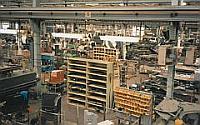
When I arrived at 27 District Workshop the state of the workshop floor was very untidy. It was a dark and gloomy place because of inadequate lighting; something the unions were constantly (and rightly) railing against. The lights were an orange argon type and this colour gave a depressing feeling to the workplace. Staff were under considerable pressure because of the reforms, aimed at sheeting home financial accountability, introduced by the Thatcher Government. In general, the staff at the workshop were highly motivated, well trained and of high quality in terms of their honesty, work-ethic and diligence. The stress of coping with sudden change though had had an adverse effect on things such as workshop tidiness and basic organisation.
27 District Workshop was the largest of all the district workshops in the UK Ministry of Defence. It undertook some overflow programme repair and so verged on being a Base Workshop. 27 District Workshop tended to be loaded with equipment which the other Base Workshops did not wish to handle for a variety of reasons. In some cases, the equipment was obsolete, the parts were always difficult to obtain and the equipment was often in a state of advanced decay. 27 District Workshops was smaller than most Base Workshops but larger than all the other District Workshops. It was therefore a good testbed. It it worked at 27 District, it would most likely be effective in all the other Base and District Workshops.
The Problem with Tray-stores
One aspect of workshop operations that was causing considerable disruption to efficient production was the matter of repair parts supply and, in particular, the supply of "ready-to-hand" parts positioned in trays on the production lines and work areas. Normally, within a workshop, there is a sub-organisation responsible for repair parts supply. When repairing an equipment, one normally attempts to perform an inspection in order to determine the parts that will be necessary to perform the repair. It is often not possible to predict all of the parts that will be required. Certain equipments also do not lend themselves to pre-inspection. With these equipments, it is necessary instead to inspect and repair at the same time. It is also not cost effective to have a totally centralised repair parts holding from which the parts are fetched every time there is an unexpected requirement. For all of these reasons, it is normal practice in a workshop to have on hand, in trays, a variety of fast moving and generally inexpensive parts for the immediate use tradesmen. These trays, for convenience of management, are generally located in groups, associated with workshop cost-centres, and spread throughout the workplace. They are referred to as "Tray-stores".
At 27 District Workshop, there were 177 tray-stores located throughout the workshop. Each tray-store consisted of as many as 500 trays with a number of parts or an assemblies being held in each tray. The average was around 50 trays per store; the total number of trays being held on the shop floor was at one time counted as being 8924 trays. In all, at that time, there were 5,598 "line-items" being held on the floor with an estimated value of £132,000.00 Sterling.
At the time of my arrival, 3 Ordnance storemen use to patrol the workshop on a continual basis, taking note of which trays required replenishment.
Tray-stores were a major source of production disruption. The problems with their managment and upkeep being:
- parts shortages generally, ie, parts not being on hand when needed;
- improper provisioning (this resulted in either no stock or too much stock);
- stock number changes leading to incorrect ordering;
- clerical mistakes leading to incorrect ordering; and
- the amount of labour that was being consumed trying to provision and generally manage the situation
A computer system, called ARROW and developed by the Royal Electrical and Mechanical Engineers (REME) Data Centre, was used to manage the stores and the production control in 27 District Workshop. ARROW ran on an ITL mini computer. It had a text and menu interface and, for its day, it was quite advanced. ARROW connected to a large number of dumb terminals throughout the workshop using RS-232, an asynchronous serial system of communications.
It was to these terminals, the Ordnance storemen would return once they had finished their patrol of the workshop
The computers were administered by a small staff headed by Mr Bob Wilcox. Bob had an assistant, Doug Bonner and between them, they were the powerhouse of the computer administration in 27 District Workshop, if not the entire REME. Them being there was an incredible coincidence of good fortune for me as will become evident later in this story.
Prior to coming to 27 District Workshop, from 1986 to 1987, I had been the Commanding Officer of 1 Base Workshop Battalion at Bulimba, a suburb of Brisbane the capital of the State of Queensland in Australia. The Australian Army had a computer system similar to ARROW in its Base Workshops. This was called MAWD, standing for Machine Assisted Workshop Documentation. MAWD purpose was twofold. Firstly it provided the means by which workshops could record the process of repairing equipment, including the ordering, consumption and control of repair parts. Secondly, it gathered data that was then inserted into a central database system called MODERNISE.
In 1980 and 1981, I was put in charge of EME Systems development in the Australian Army. In that capacity, I conceived and developed a new family of computer systems,
EMEDATER and EMEMic, the emphasis of which was that of helping people perform their work in the workplace; the logic being that if the systems achieved that aim then the data that would be a by-product of this would be accurate and complete; something that the data in MODERNISE was not. I saw microprocessors as they were called in those days as being the future. I wanted the Australian Defence Force to adopt a microprocessor called the Onyx. It ran a Motorola 48000 chip with a 64 bit Math Coprocessor and came equipped with a revolutionary storage device called a Winchester Drive, capable of storing a massive 40 Megabytes of data. The Onyx could support up to 4 megabytes of dynamic RAM and ran the UNIX operating system. The C programming language was commonly used to write applications on this computer but high level compilers for FORTRAN and COBOL were either available or under development. The Onyx cost $4,000.00, imported from the US. I drove to Sydney to see one just to make sure it was not a figment of a sales-executive's imagination. Instead of buying the Onyx, Computing Services Division, then the centre of the Defence Computing Bureaucracy chose to purchase the newly arrived IBM PC. It too cost around $4,000.00 (a friend of mine bought one of the first ones to come to Canberra!) but it was only a shadow of the Onyx. Besides not having a true 16 bit architecture, unlike the Motorola chip, the IBM 8088 could not handle data and graphics at the same time. The PC could only support 256 kilobytes of dynamic RAM and did not have a hard drive. Importantly, even though IBM claimed the PC could be networked using RS-232, a bug in the BIOS meant that every time the PC wrote to the screen, the Programmable Interrupt Controller that handled the Universal Asynchronous Receiver Transmitter, essential for RS-232 communications, was disabled; thereby effectively preventing reliable RS-232 communications.
In EME Systems Development, my objective was to develop mobile systems that would help people in the workplace. This meant using PCs. For their own reasons, Computing Services Division and the Defence computing bureaucracy in general, did everything possible to slow down the introduction of these machines in the workplace. As a part of this, I wanted to interface PCs with the Defence Standard Mini-computer, then Perkin Elmers. Like the IBM PC, the choice of the Perkin Elmer mini-computers by the Defence bureaucracy was a terrible one. All programs in the Defence Computing Environment had to be written in Common Assembly Language. This was because the cost of having sufficient magnetic core memory in a Perkin Elmer to allow programming in a high level language such as FORTRAN or even BASIC was prohibitive. I saw PCs as a means of bridging the gap. The PCs could be easily programmed in a new language called "Turbo Pascal" to do detailed tasks and the mini-computers could be relegated to being large storage devices and the means by which data was passed to central databases. Over a period of time, the mini-computers could be phased out altogether. I was told by CSD that it was impossible to interface an IBM PC with a Perkin Elmer mini-computer.
When I became CO of 1 Base Workshop Battalion, with the approval of the Chief of Staff of the First Military District, Colonel Ford, I used local purchase funds to purchase an Amstrad 512 PC for a little over $1,000. This was at a time when dumb terminals for Perkin Elmer Mini-computers cost around $4,000.00! With the help of a friend Lieutenant Stevan Vujovic, I learnt how to program in Turbo Pascal and Steve obtained for me a library of routines written by Blaise Computing in the US that enabled an IBM PC to communicate using RS-232. With the help of my Electronics Instruments and Radio Platoon, I constructed a switchbox that allowed me to "listen" to all of the characters passing between a Perkin Elmer terminal and the Perkin Elmer mini-computer and it was not long before I had written the code necessary to allow an IBM PC to imitate a Perkin Elmer terminal; something CSD had claimed was impossible to do. Using this facility, I quickly wrote an application that allowed me to raise jobs on the MAWD mini-computer for the purposes of achieving a comprehensive system of Time Accounting within 1 Base Workshop; something that had never been achieved anywhere in the Australian Army (and this remains so to this day!). A life-long friend of mine, Graham Smith, was the CO of 3 Base Workshop Battalion in Broadmeadows, Melbourne, Victoria. I shared my work with him and he installed the same system into 3 Base Workshop.
So when I came to 27 District Workshop, I brought all of this knowledge, my code and my switchbox. When I saw the problems with repair parts I saw how it would be possible to largely automate the resupply of tray-stores in 27 District Workshop using barcodes.
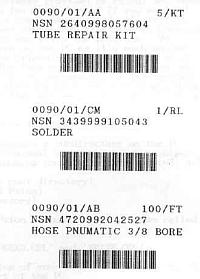
The System involved the development of 3-of-9 barcode software and a total
system of handheld readers based on inexpensive PSION Organisers.
3-of-9 is significant because it is a barcoding system for encoding
both numeric and alphabetical characters. This System was used by the
British Army for 15 years. Further developing this system, wrote a
calibration management system to manage all calibration of test
equipment within the British Army. All software written in own time in
Turbo Pascal on an IBM compliant PC. System was written in 6 man-months
whereas the EME Data Centre had budgeted 15 man-years. This software
saved 7 manpower positions at 27 District Wksp whilst almost entirely
eliminating stock-outs and problems relating to superseded NATO Stock
Numbers. In all it was calculated that, across the whole British Army,
these systems had the capacity to save around thirty million pounds per
annum. Introduced into all Base and District Workshops.